



You’ve read it a hundred times. You could recite it in your sleep. And yet, every night, your child hands you the exact same book and says, “Again!” If you’ve ever asked yourself why does my child read the same book over and over, and wondered whether you should be steering them toward something new, you’re not alone — and the answer might surprise you.
In this guide, we’ll look at the research behind why kids read the same book over and over, what it actually does for a developing brain, when it’s worth gently encouraging variety, and how to support this habit without losing your own sanity at bedtime.
Why Does My Child Read the Same Book Over and Over? The Real Reasons
Repetitive reading can feel baffling to adults, but from a child’s point of view, it makes complete sense. Three things are usually happening at once when your child reads the same book over and over.
Familiarity feels safe
A favorite book is predictable in a world that mostly isn’t. Children don’t get much say over their daily schedule, their meals, or their bedtime — but they can choose the same story every night. That predictability is genuinely comforting, especially during periods of change, stress, or big emotions. A familiar book works a bit like a favorite blanket: the ending never changes, and that’s the point.
It builds mastery and confidence
Think about how a child learns to ride a bike. They don’t master balance after one attempt — they need the same motion, repeated, until it becomes automatic. Reading works the same way. Each time a child returns to a familiar book, they recognize more words, predict what happens next with more accuracy, and notice details they missed before. What looks like repetition to us is active practice to them.
It’s a way of exercising control
Requesting the same book — and getting it — is one of the few moments in a young child’s day where their choice is honored outright. That small sense of agency matters more than it might seem, particularly for toddlers and preschoolers who spend most of their day following adult-led routines.
👉 Related reading: How to Build a Reading Routine for Kids That Actually Sticks
The Hidden Literacy Benefits of Reading the Same Book Again and Again
Reading the same book over and over isn’t just emotionally comforting — it’s one of the more effective, lowest-effort ways young children build real reading skills.
- Reading fluency. Hearing or reading the same text multiple times helps children recognize words faster and read with more natural rhythm and expression — a skill called fluency, and one of the strongest predictors of later reading success.
- Vocabulary growth. Contrary to the assumption that variety builds vocabulary fastest, a study published in Frontiers in Psychology found that children often learn new words more reliably from a familiar, repeated text than from hearing several different books that use the same words only once.
- Deeper comprehension. As a child’s brain develops between readings, their understanding of the same story deepens. The book stays the same — the reader doesn’t. A three-year-old and a four-year-old can pull very different meaning from the exact same page.
- Print and story structure awareness. Repetition helps children internalize how stories work — beginning, middle, end, cause and effect — which supports comprehension skills they’ll carry into new books later.
For more on the science behind how children learn to decode and comprehend text, Reading Rockets offers research-based guidance for parents and educators.

👉 Related reading: How to Improve Reading Fluency in Kids: A Parent’s Complete Guide
Is It a Problem If My Child Reads the Same Book Over and Over?
Short answer: almost never. For the vast majority of children, rereading a favorite book — even the same one for weeks or months — is a normal, healthy part of literacy development, not a red flag. Parents often reach out worried that a two-year-old asking for Brown Bear, Brown Bear every single night for six weeks means something is “off.” In most cases, it just means the book is doing its job.

It’s worth paying closer attention only if the habit is paired with other signals, such as:
- Strong distress or meltdowns when a new book is introduced, beyond typical preference or a simple “no thanks”
- No interest in any other books, activities, or topics over a long stretch of time — not just a strong favorite, but a total refusal to engage elsewhere
- Repetitive behavior that shows up rigidly across many areas of daily life, not just books — for example, insisting on the same food, same clothes, and same routine with visible distress at any change
- A noticeable regression in other language or social milestones alongside the rigid book preference
If that combination sounds familiar, it’s worth mentioning to your child’s pediatrician or teacher — not because rereading itself is a concern, but because they can look at the full picture alongside everything else you’re seeing. On its own, a child who reads the same book over and over has simply found something that works for them, and that’s worth celebrating rather than worrying about.
How to Support Rereading While Encouraging Variety
You don’t have to choose between honoring your child’s favorite book and expanding their reading world. These two things can happen side by side.
- Keep reading the favorite — without guilt. The repetition is doing real developmental work, even on read number fifty.
- Add new books alongside, not instead of. Introduce a new title occasionally without removing access to the old favorite. Framing it as “let’s meet a new book too” feels safer than “we’re done with this one.”
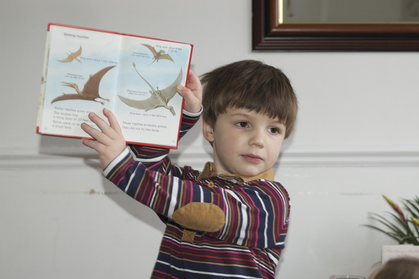
- Follow the thread of what they love. If your child adores a book about dinosaurs, look for other dinosaur books, or other titles by the same author or illustrator. You’re much more likely to land a new favorite this way than with something unrelated.
- Ask questions inside the familiar story. Even on the hundredth read, asking “What do you think happens next?” or “Why do you think she did that?” pushes comprehension further without needing a new book.
- Let them lead some sessions, and you lead others. Alternate whose pick it is for storytime, so new books get regular airtime without a fight.
- Watch for natural transition points. Interest in a favorite book often fades on its own once a child has fully mastered it — trust that timeline rather than rushing it.
👉 Related reading: Understanding Reading Levels for Kids
Rereading by Age: What’s Typical
Why a child reads the same book over and over often looks a little different depending on their age and stage. A toddler’s attachment to a single board book serves a different developmental purpose than a seven-year-old rereading the same chapter book series. Here’s a general guide to what’s typical at each stage, though every child moves through these at their own pace.

| Age | How Rereading Usually Shows Up | What It’s Building |
|---|---|---|
| 1–2 years | Requesting the same short board book repeatedly, often several times a day | Comfort, routine, early word recognition |
| 3–4 years | A “current favorite” that can last weeks or months, sometimes memorized word-for-word | Story structure, vocabulary, sense of mastery |
| 5–6 years | Rereading favorites while also picking up new books more readily | Fluency, comprehension, growing independence |
| 7+ years | Rereading specific series or chapter books rather than picture books | Fluency at a higher text level, comfort during transitions (new school year, new sibling, etc.) |
Final Thoughts
If your child hands you the same book for the tenth night in a row, you don’t need to worry — and you don’t need to force a switch. So why does your child read the same book over and over? Because it’s one of the most natural, low-effort ways young children build fluency, vocabulary, and confidence, all while getting the comfort of something familiar. The next time you groan internally at hearing that title again, it may help to remember: for your child, that book isn’t old news. It’s still teaching them something new every single time.
FAQ: Why Does My Child Read the Same Book Over and Over?
Why does my child read the same book over and over?
Children reread favorite books because the predictability feels comforting, and the repetition helps them build fluency, vocabulary, and confidence. It’s also one of the few areas where they get to make the choice themselves.
Is it bad for a child to read the same book too many times?
No. Rereading a favorite book is a normal and beneficial part of early literacy development. It only becomes worth a closer look if it’s paired with strong distress around any new books or activities, which is best discussed with a pediatrician or teacher.
How do I get my child to read different books?
Introduce new titles alongside the favorite rather than replacing it, and look for books connected to what they already love — same author, same topic, or a similar theme. Let them keep the familiar book in rotation while new ones are added.
At what age do kids stop rereading the same book?
There’s no fixed age — it varies by child. Many children naturally move on from a favorite once they’ve mastered it, though some rereading (of favorite series or authors) continues well into the elementary years.
Does rereading actually help kids learn to read?
Yes. Research on repeated reading shows it strengthens word recognition, reading fluency, and even vocabulary retention, often more effectively than reading a wider variety of books just once each.


Harika yazı! Wan 3.0 text-to-video: WanVideoGen — . WanVideoGen